

Student Name
Capella University
NURS-FPX4025 Research and Evidence-Based Decision Making
Prof. Name
Date
Analyzing a Research Paper
Figure 1
Keywords: Gout disease, Telemedicine, Likert scale, Patient satisfaction, Telephone-based management program, Serum uric acid
Reference:
Al Harash, A., Laginya, G., & Ayoub, W. T. (2021). Efficacy and outcomes of a novel telephone-based gout disease management program. The Open Rheumatology Journal, 15(1), 51–56. https://doi.org/10.2174/1874312902115010051
Date of Publication: 11 August 2021
Research Article Evaluation
Type of Study
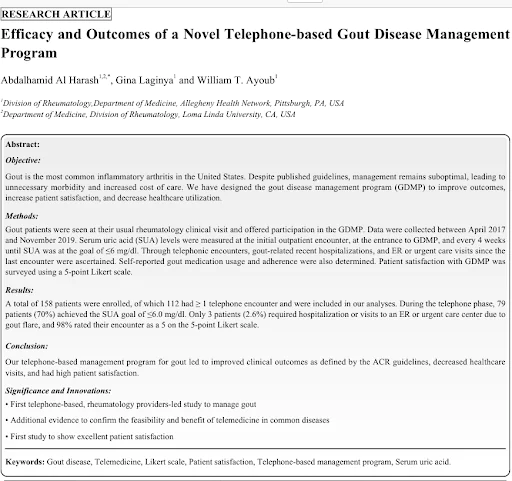
The study conducted by Al Harash et al. (2021) is a research article that reports on a prospective quality improvement initiative utilizing a telephone-based management program for gout. This approach primarily focuses on enhancing patient care outcomes and monitoring adherence to therapy through telecommunication rather than traditional face-to-face consultations.
Pyramid Level
This research falls under Level V of the evidence pyramid, as it is classified as a quality improvement (QI) project. Level V evidence typically includes non-research evidence such as program evaluations, case reports, or expert opinions, and does not involve controlled experimental methods.
Methodology
The study enrolled 158 patients diagnosed with gout from 2017 to 2019. All participants received standard rheumatology care initially, followed by structured telephone-based management. During phone follow-ups, clinicians monitored serum uric acid (sUA) every four weeks until treatment targets were achieved. The study also tracked medication adherence and assessed patient satisfaction using a Likert scale. This systematic approach allowed for consistent monitoring of disease progression and response to treatment.
Credibility Factors
Several elements contribute to the credibility of this study:
| Factor | Description |
|---|---|
| Providers | Rheumatology specialists conducted the study. |
| Sample Size | A relatively large cohort of 158 patients enhances reliability. |
| Ethical Considerations | The project had an IRB exemption as a QI initiative. |
| Data Collected | Clinical outcomes (sUA levels) and patient-reported satisfaction were included. |
| Limitations | Lack of a control group reduces generalizability to broader populations. |
Relevance to Diagnosis
The study is clinically significant as it demonstrates that telephone-based monitoring enables gout patients to achieve target serum uric acid levels (≤6 mg/dl), which is associated with reduced disease flares and complications. Additionally, it underscores telemedicine as a cost-effective, patient-centered strategy for managing chronic conditions like gout.
Workplace Application
Telephone-based follow-ups can be integrated into routine clinical practice to reduce travel and clinic costs for patients. Providers can adjust medications promptly, monitor sUA levels remotely, and reinforce adherence, ultimately reducing the incidence of flares and expensive emergency care. This method supports proactive, efficient management of chronic diseases.
Sentinel U Patient
Figure 2
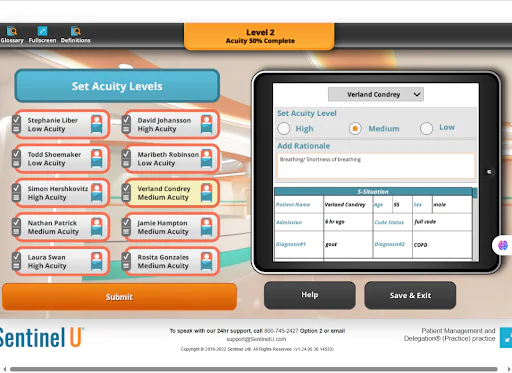
| Patient Information | Details |
|---|---|
| Name | Verland Condrey |
| Diagnosis | Acute exacerbation of gout with left lower extremity inflammation |
| Treatment | Intravenous fluids, intravenous colchicine, PCA (patient-controlled analgesia) |
| Care Plan | Monitor for shortness of breath, manage pain rated 8/10, provide supportive care, assess response to medications and fluids |
Summary of Findings
Al Harash et al. (2021) conducted a telephone-based gout disease management program with 158 participants, of which 112 were successfully followed in at least one structured phone encounter. The primary objective was to improve clinical outcomes by maintaining sUA levels at or below 6 mg/dl, in alignment with standard treatment guidelines.
Patients received regular telephonic monitoring, including evaluation of lab results, medication adjustments, and reinforcement of therapy adherence. Serum uric acid was measured every four weeks until patients reached target levels. By the end of the study, 70% of participants achieved the desired sUA target. Furthermore, medication adherence improved, and the incidence of hospitalizations and emergency department visits due to gout flares decreased significantly.
Patient-reported outcomes indicated high satisfaction, highlighting the practicality and patient-centered design of the program. Telephonic follow-ups reduced the need for frequent clinic visits, providing a convenient and cost-efficient alternative. Overall, the study suggests that structured telephone management is an effective approach for improving adherence, preventing complications, and enhancing patient outcomes in gout care.
Relevance and Potential Effectiveness of Evidence
The study’s findings are highly relevant to gout management. Achieving target uric acid levels is essential for controlling disease progression, preventing flares, and reducing hospital admissions. Frequent follow-ups via telephone were shown to improve adherence to urate-lowering therapy, demonstrating that remote management can be an effective alternative to traditional in-person visits.
The article is credible due to publication in a peer-reviewed rheumatology journal, a sizable sample, and well-structured data collection. Its primary limitation is the absence of a control group, preventing direct comparison with standard care. Despite this, the high patient satisfaction and improved clinical outcomes support the application of telephone-based programs in clinical practice. Nurses and healthcare providers can leverage telemedicine to enhance patient-centered care, optimize adherence, and achieve better disease management outcomes.
NURS FPX 4025 Assessment 1 Analyzing a Research Paper
Article Link: https://doi.org/10.2174/1874312902115010051
References
Al Harash, A., Laginya, G., & Ayoub, W. T. (2021). Efficacy and outcomes of a novel telephone-based gout disease management program. The Open Rheumatology Journal, 15(1), 51–56. https://doi.org/10.2174/1874312902115010051